
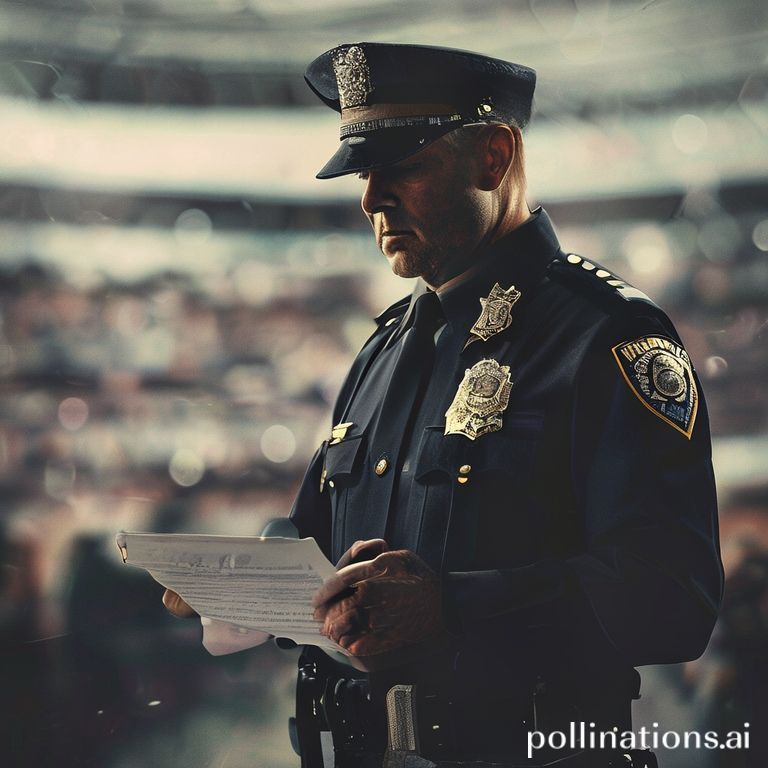
TL;DR: Police Chief Craig Guildford has announced his retirement, citing a "political and media frenzy" that erupted after his force considered banning Israeli fans from an upcoming international event. The controversy, which saw accusations of politicizing security decisions, highlights the complex pressures faced by law enforcement when geopolitical tensions intersect with public events.
A Sudden Departure Under a Cloud of Controversy
Craig Guildford, a seasoned law enforcement veteran with a reputation for steady leadership, has confirmed his decision to retire, casting a long shadow over his force and the political landscape. The chief constable’s departure comes in the wake of an intense public and political firestorm, ignited by a proposal to ban Israeli supporters from attending a major international sporting event – a decision Guildford now attributes to an unbearable "frenzy."
The announcement, made earlier this week, has sent ripples through both policing circles and government offices. While Guildford's exact retirement date remains unspecified, the immediate trigger for his resignation is unequivocally linked to the fallout from his force's operational assessment regarding fan attendance at the controversial fixture.
The Genesis of a Political Powder Keg
The controversy began several weeks ago when police forces responsible for security at a high-profile international event flagged concerns about potential public order disturbances. Among the proposed measures, reportedly driven by intelligence assessments of likely protests and counter-protests, was a temporary restriction on individuals identified as overt supporters of the Israeli national team or cause. The aim, according to initial leaked reports, was to mitigate significant security risks and prevent the event from becoming a flashpoint for geopolitical tensions.
However, the moment this proposal entered the public domain, it exploded. Critics immediately decried the move as discriminatory and politically motivated, arguing that it unfairly targeted individuals based on nationality or political affiliation. "This isn't about security; it's about appeasing an agenda," stated one prominent MP on social media, echoing a sentiment that quickly gained traction across the political spectrum.
The national conversation spiraled, morphing from a discussion about public order policing into a heated debate about free speech, national identity, and the role of police in politically charged environments. Human rights organizations weighed in, expressing concern over potential precedents for collective punishment or discrimination. According to the BBC, Chief Guildford explicitly blamed the "political and media frenzy" for his decision to step down, emphasizing the immense pressure he and his department faced.
Between a Rock and a Hard Place: Policing in a Politicized Era
For Guildford, the operational decision was, he maintained, purely about risk management. Police forces regularly assess potential threats and deploy measures to ensure public safety at large gatherings. In a world increasingly shaped by global conflicts and their domestic repercussions, major events often become unwitting stages for international dissent. The challenge for law enforcement, particularly in democracies, is to balance the right to protest with the need to prevent violence and disorder.
"When intelligence suggests a significant risk of disorder, and that risk is exacerbated by the presence of identifiable groups whose very presence could incite violent confrontation, operational commanders have a duty to consider all measures," explained a former senior police officer, speaking anonymously to PPL News Live. "The problem arises when those operational considerations are immediately translated into political statements, regardless of intent."
Indeed, the government, while initially cautious, was eventually drawn into the fray. Ministers faced calls from various factions to either condemn the proposed ban as discriminatory or to defend the police's right to operational independence. Reuters reported extensive lobbying from advocacy groups on both sides, putting immense pressure on the Home Office to issue a definitive statement. The tightrope walk proved precarious, with any utterance risking alienating a significant part of the electorate.
The Unintended Consequences of Scrutiny
The intense scrutiny, Guildford suggested, made his position untenable. The "frenzy" he cited wasn't just critical commentary; it was a sustained, often vitriolic, campaign that blurred the lines between genuine security concerns and perceived political bias. This environment, he argued, made it impossible to continue leading effectively.
His resignation serves as a stark reminder of the delicate balance police chiefs must strike. They are expected to be independent arbiters of public safety, making decisions based on threat assessments and resource allocation, yet they operate within a highly politicized ecosystem. Every major decision, especially one touching on international relations or identity politics, is dissected, debated, and often distorted through partisan lenses.
An analysis by The Associated Press highlighted a growing trend where local policing decisions, once largely insulated, are becoming increasingly susceptible to national and even international political pressures, often amplified by social media. This interconnectedness means that what might have once been a local security briefing can now become a global headline overnight, attracting the attention of governments, NGOs, and activist networks far beyond national borders.
Looking Ahead: A Void and Lingering Questions
Guildford's departure leaves a significant void. He had been a vocal proponent of community-led policing and had overseen several initiatives aimed at building trust between the force and diverse populations. His exit raises questions about the future leadership of the force and, more broadly, about the capacity of policing to navigate an increasingly complex and polarized societal landscape.
The incident also prompts a critical re-evaluation of how societies discuss and respond to security measures in politically sensitive contexts. Is there a way for law enforcement to communicate its operational rationale without immediately inviting accusations of bias? Or is the current media and political environment such that any such decision, if it touches upon a hot-button issue, is inevitably destined for a "frenzy"?
The controversy surrounding the Israeli fan ban, culminating in a police chief's resignation, underscores a profound dilemma. It’s a conflict between the imperative for public safety, the principles of non-discrimination, and the realities of a hyper-connected, hyper-partisan world. As the dust settles on Guildford's career, the fundamental questions about policing autonomy and the weaponization of public discourse remain very much unresolved. CNN commentators have already begun speculating about the chilling effect this high-profile resignation might have on other police leaders facing similar dilemmas in the future.
Editorial Note from PPL News Live:
Chief Guildford’s resignation is a sobering moment for public service. While the specifics of the proposed fan ban undeniably warranted public scrutiny and debate, the ferocity of the "frenzy" he describes speaks to a broader issue in our contemporary discourse. When operational decisions, made with public safety as their stated priority, are immediately and relentlessly politicized to the point of driving out experienced leadership, it raises serious questions about the environment in which our institutions are expected to function. Finding a way to hold power accountable without demonizing every difficult decision is crucial if we are to maintain effective, independent public services.
Edited by: Editorial Desk
Sources
- Reuters
- Associated Press (AP)
- AFP
- BBC News
Published by PPL News Live Editorial Desk.